
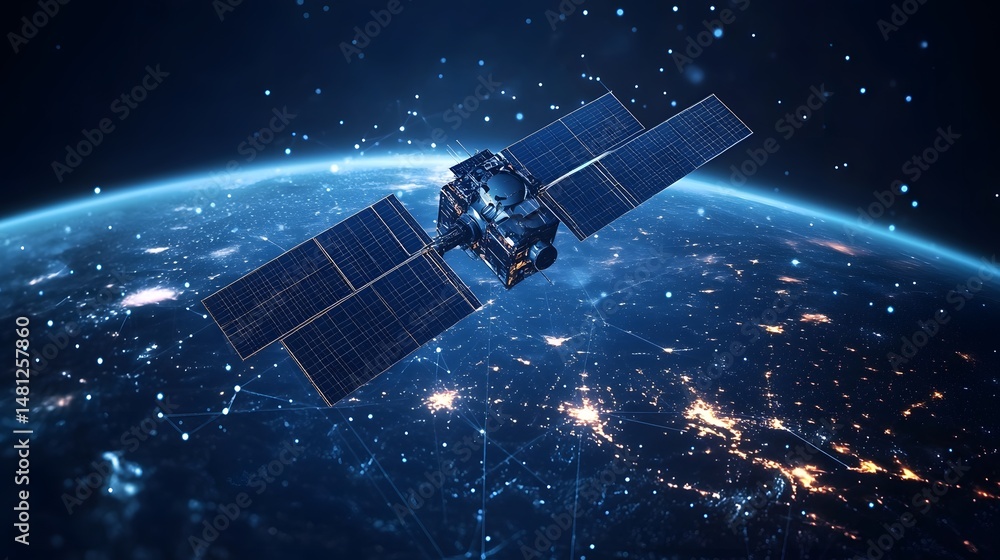
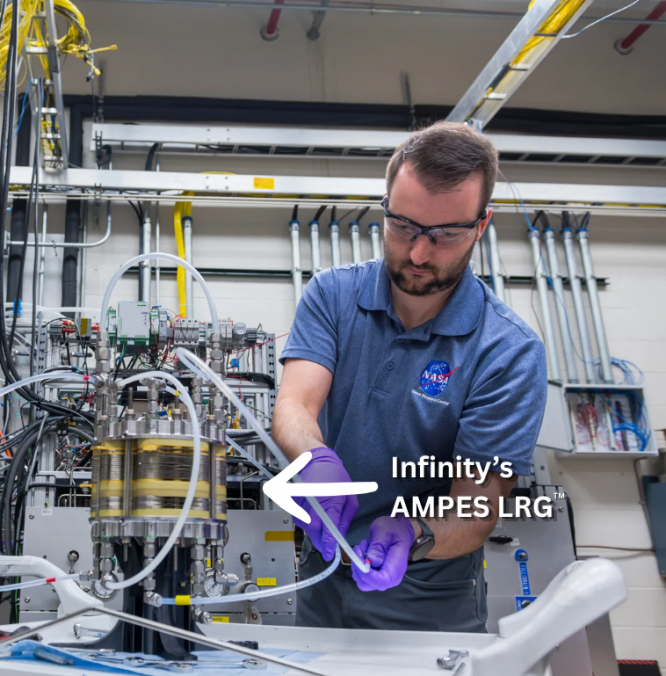
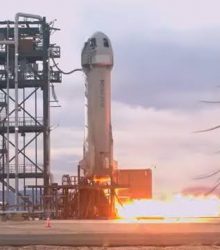
Zero-emission, high-energy-density, and flight-proven fuel cell solutions engineered to operate reliably under the demanding conditions of spaceflight and lunar exploration. Our AMPES next-gen, NASA funded, space fuel cell has flown and operated successfully on two Blue Origin New Sheppard sub-orbital flights.
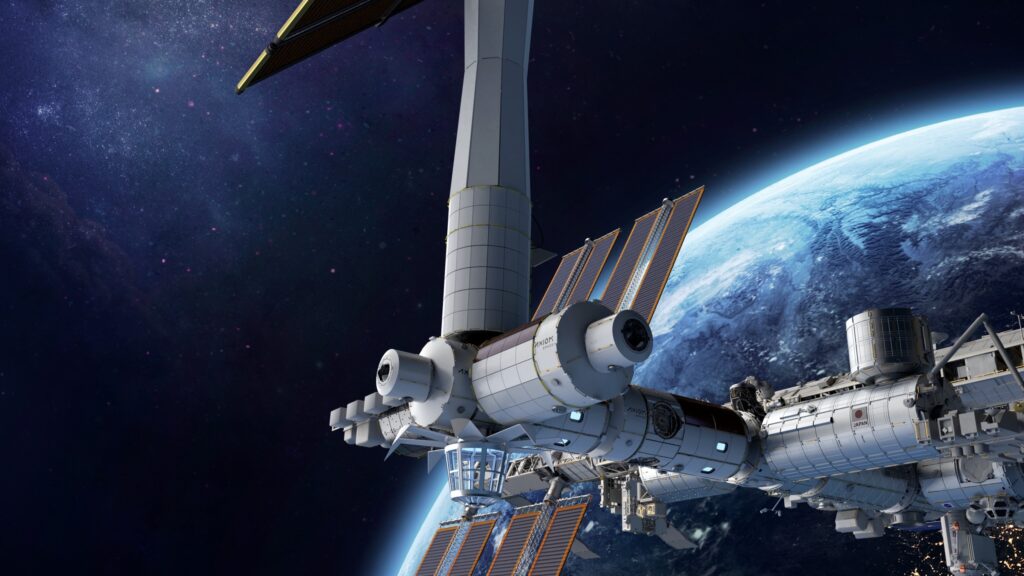
Life Support: Infinity’s space electrolyzer is being developed for one of NASA’s commercial space station partners to provide the breathable air for astronauts on a commercial space station.
The Capability: For manned space stations and capsules, a tremendous benefit of Infinity’s fuel cell systems is the production of ultra-pure water as a byproduct. At 1 kg/L (8.34 lb/gal), generating water onboard from vehicle propulsion fuel and oxidizer provides enormous weight savings at launch. This same water can be recycled and electrolyzed to produce breathable oxygen for crew life support and hydrogen for orbit boosting.
The Capability: For crewed space stations and capsules, a tremendous benefit of Infinity’s fuel cell systems is the production of ultra-pure water as a byproduct. Generating water onboard from hydrogen and oxygen already carried for propulsion and power generation can provide significant launch mass savings by reducing the amount of water that must be transported from Earth. This water can be recycled and electrolyzed to produce breathable oxygen for crew life support and hydrogen for future energy storage or propulsion applications.
The Application: Infinity has successfully developed and demonstrated rugged fuel cell power solutions for rover vehicle platforms at both NASA Glenn Research Center and NASA Johnson Space Center, testing systems through traditional, representative mission profiles.
The Application: Infinity has successfully developed and demonstrated rugged fuel cell power solutions for rover vehicle platforms at both NASA Glenn Research Center and NASA Johnson Space Center, validating system performance through representative mission profiles.
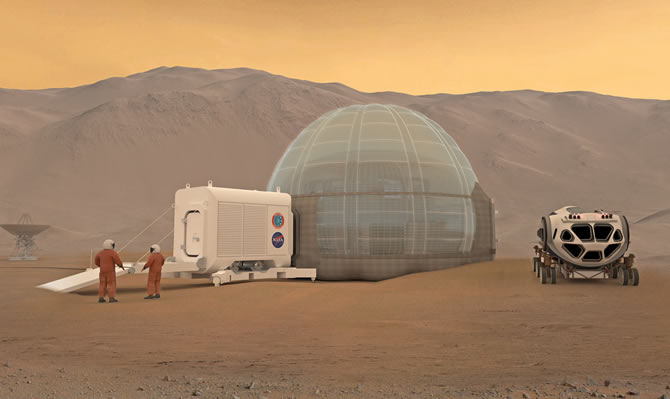
The Solution: Infinity is partnering with the NASA Glenn Research Center to provide the core fuel cell components for a Lunar Regenerative Fuel Cell (RFC) system. By storing energy efficiently, these systems can support continuous surface operations through the deep lunar night.
The Challenge: The lunar night lasts approximately 14 Earth days, creating prolonged periods of darkness and extreme cold. Sustained surface operations require reliable, high-capacity energy storage to maintain functionality during extended periods without sunlight. Conventional battery systems can introduce significant mass, volume, and cost challenges for long-duration missions.
The Solution: Infinity is partnering with the NASA Glenn Research Center to provide the core fuel cell components for a Lunar Regenerative Fuel Cell (RFC) system. By storing energy efficiently, we can power a continuous surface base through the deep lunar night.
The Challenge: The lunar night is long, dark, and freezing, lasting 14 Earth days. Non-nuclear surface operations completely fail without dense energy storage. Traditional battery systems carry extreme mass, weight, and high-cost penalties.